Category: Uncategorized

  • What Custom Pencils Are Made Of: Wood, Graphite Grades and the Safety Marks That Matter

    What Custom Pencils Are Made Of: Wood, Graphite Grades and the Safety Marks That Matter

    Two custom pencils can look identical on a product page and feel completely different in the hand. The gap comes down to what they are actually made of: the wood around the core, the graphite blend inside it, the coats of lacquer on the barrel, and the certifications that back up the safety claims on the box. If you are ordering printed pencils for a school, a trade show or a retail gift set, understanding these materials lets you write a spec that gets you the writing feel and the compliance paperwork you need, rather than whatever the cheapest factory happens to run that week.

    The Wood Casing Sets the Feel

    Genuine incense-cedar is the benchmark wood for a good pencil. Grown in the United States, it has a smooth, straight grain, sharpens evenly without splintering, and is soft enough to spare your sharpener while still holding a point. When a supplier quotes incense-cedar, you are getting the casing used in premium writing pencils. Budget barrels are more often basswood, white fir or poplar, and in the lower tiers you may see jelutong or other tropical species. These sharpen adequately but tend to splinter more and wear blades faster.

    Two things are worth avoiding. Tropical and pitted woods, recognizable by small holes in the grain, are frequently harvested unsustainably. Extruded plastic “pencils” sidestep wood entirely but sharpen poorly and are not biodegradable, which undercuts the eco message that draws many buyers to a wood pencil in the first place. If sustainability is part of your pitch, ask whether the cedar is from a managed source, and consider recycled-material barrels as a deliberate, disclosed choice rather than a hidden downgrade.

    Graphite Grades and What “#2” Really Means

    The core is not lead and never has been in a modern pencil; it is a fired mix of graphite and clay, and the clay ratio sets the hardness. More clay yields a harder, lighter-writing core; more graphite yields a softer, darker one. The grading scale runs from 9H at the hardest, lightest end to 9B at the softest, darkest end, with HB in the middle. In American terms, a #2 pencil is simply an HB, which is why standardized tests call for it: dark enough to read and scan, hard enough not to smudge across a page.

    Most eraser-tipped pencils sensibly land between 2H and 4B, and for a printed giveaway or classroom pencil, HB is almost always the right default. It is worth knowing that no single legally standardized graphite scale exists, so one maker’s HB can be a touch darker than another’s. Quality also shows in whether the graphite is centered in the wood; an off-center core sharpens unevenly and snaps more easily. If your order is for writing rather than display, ask the factory to confirm the grade and that the core is centered.
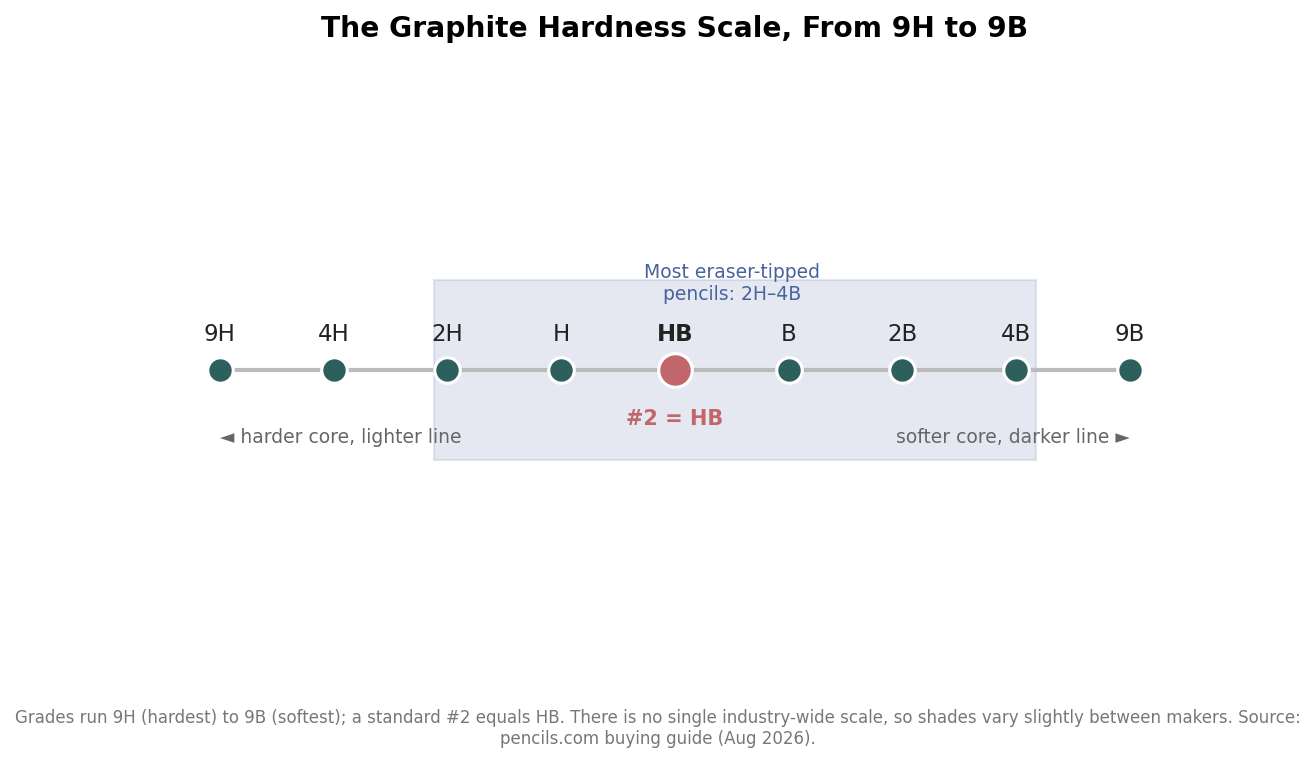
    Number line of the graphite hardness scale from 9H hardest to 9B softest, with HB marked as the #2 pencil and the 2H to 4B common band highlighted
    The graphite grading scale, with the standard #2 (HB) and the common eraser-pencil band marked.

    Lacquer, Ferrules, and Erasers

    The barrel finish is where cost differences become visible. Entry-level pencils typically get around three coats of lacquer, while premium pencils can carry seven or more, which is what gives a high-end barrel its deep, even color and smooth feel. For a printed pencil this matters twice over: a well-built lacquer base takes an imprint more cleanly and resists chipping around the print. The metal ferrule that holds the eraser is the other tell. Crimped ferrules are common and leave small indentations in the wood; glued ferrules are sturdier and look cleaner, and are the mark of a better-made pencil.

    Erasers themselves vary from hard, smeary economy rubber to softer, cleaner-lifting compounds. If your pencils are meant to be used rather than kept, a decent eraser is a small upgrade that people notice every time they reach for it. None of these details changes the printed logo, but together they decide whether the pencil feels like a keepsake or a throwaway.
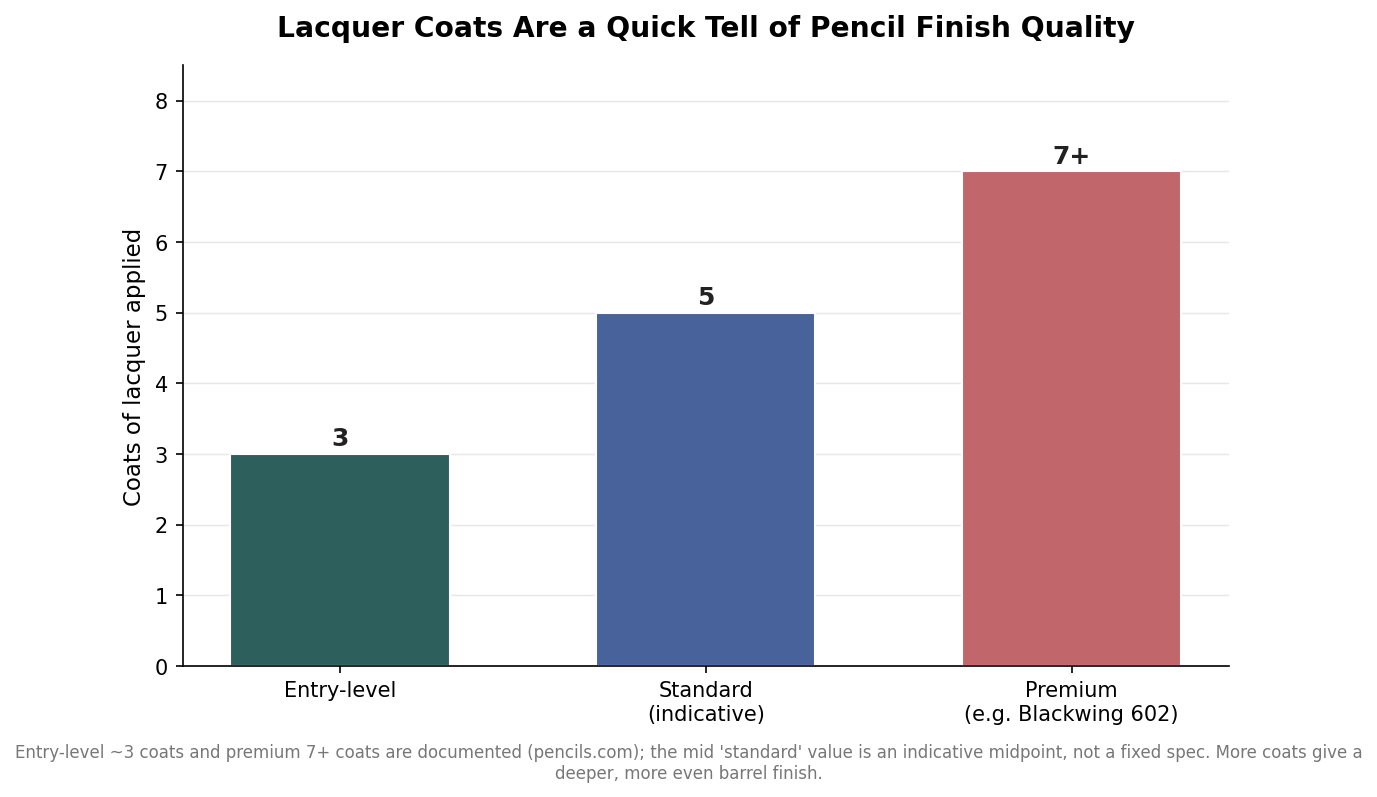
    Bar chart of lacquer coats by pencil tier: entry-level about 3 coats, standard about 5, premium 7 or more
    More coats of lacquer signal a better barrel finish that also holds an imprint more cleanly.

    The Safety Marks That Matter

    Because pencils are handled by children and marked as art materials, several certifications govern what a compliant one must carry. In the United States, ASTM D4236 is the “Standard Practice for Labeling Art Materials for Chronic Health Hazard,” and it requires that materials be reviewed for potential toxic content and labeled accordingly. For sale in Europe, pencils fall under the CE mark and specifically EN71 Part 3, the toy-safety standard covering migration of certain elements. A stricter industry layer is the PMA seal from the Writing Instrument Manufacturers Association, which requires component raw materials to be tested and independently verified by a third-party toxicologist, with annual recertification.

    The practical takeaway is to name the standard you need up front. A pencil going into children’s hands or a school district usually needs documented ASTM D4236 compliance, and anything shipping to the EU needs the EN71 basis for its CE mark. Confirm that the certification covers the surface coating and the eraser, not just the core, since coatings are where the labeling standards focus their attention.

    Specifying Material and Compliance in Your Order

    Turn all of this into a short brief before you buy. State the wood you want, the graphite grade, whether you require a centered core, the ferrule type, and the exact safety standard the finished pencil must meet, along with a request for the test documentation. Ask for a pre-production sample so you can check the sharpening, the imprint adhesion on the lacquer, and the feel of the eraser in person. A supplier who can answer each of those points precisely is one who controls their own materials; a vague answer on wood species or certification is the clearest early warning that the pencil will not be what your artwork promises.
  • How to Specify Custom Pencil Printing: Imprint Methods, Colors, and Artwork

    How to Specify Custom Pencil Printing: Imprint Methods, Colors, and Artwork

    The single decision that shapes a custom pencil order is not the color or the wording. It is the imprint method, because the method you choose sets a ceiling on how many colors you can run, how large the artwork can be, and which pencil shapes are even on the table. Get that one choice right and the rest of the specification falls into place. This walkthrough takes you through the four common ways a logo or message gets onto a wood pencil, and shows you how to write a spec a manufacturer can quote without a dozen follow-up emails.

    Match the method to the pencil shape first

    Pencil shape and imprint method are linked, so start with the physical pencil. A standard hexagonal pencil runs about 0.275 inches across the flats and 7.5 inches long; a round pencil is close in length but a touch fatter at roughly 0.284 inches in diameter. Carpenter pencils are a flat oval, around 0.3 by 0.55 inches and 7 inches long, while golf or bridge pencils are much shorter, at roughly 3 to 6 inches. Those numbers matter because a flat carpenter face and a curved round barrel present very different printing surfaces. Text-only logos sit comfortably on the flat facets of a hex pencil, whereas a wraparound photographic design needs a round barrel that a film can shrink onto evenly. If you already know the pencil style, tell the supplier up front, because it immediately narrows the sensible imprint options.

    Foil stamping: one clean color, sized for text

    Foil stamping is the traditional pencil imprint, and it is still the right call for a lot of orders. A heated die presses colored foil directly into the wood, leaving a crisp, slightly recessed line. It is a one-color process, typically drawn from a set of around 22 stock foil colors including the familiar golds and silvers, and it excels at type and simple line marks rather than gradients or fine detail. Expect a modest one-time die charge, often in the range of $25 for a custom die, and be aware that many pencil makers set foil type in all capitals by default unless you supply your own artwork. If your job is a company name, a school, an event date, or a short slogan in a single color, foil is usually the cleanest and most economical route.

    Screen, wrap, and digital: your multi-color options

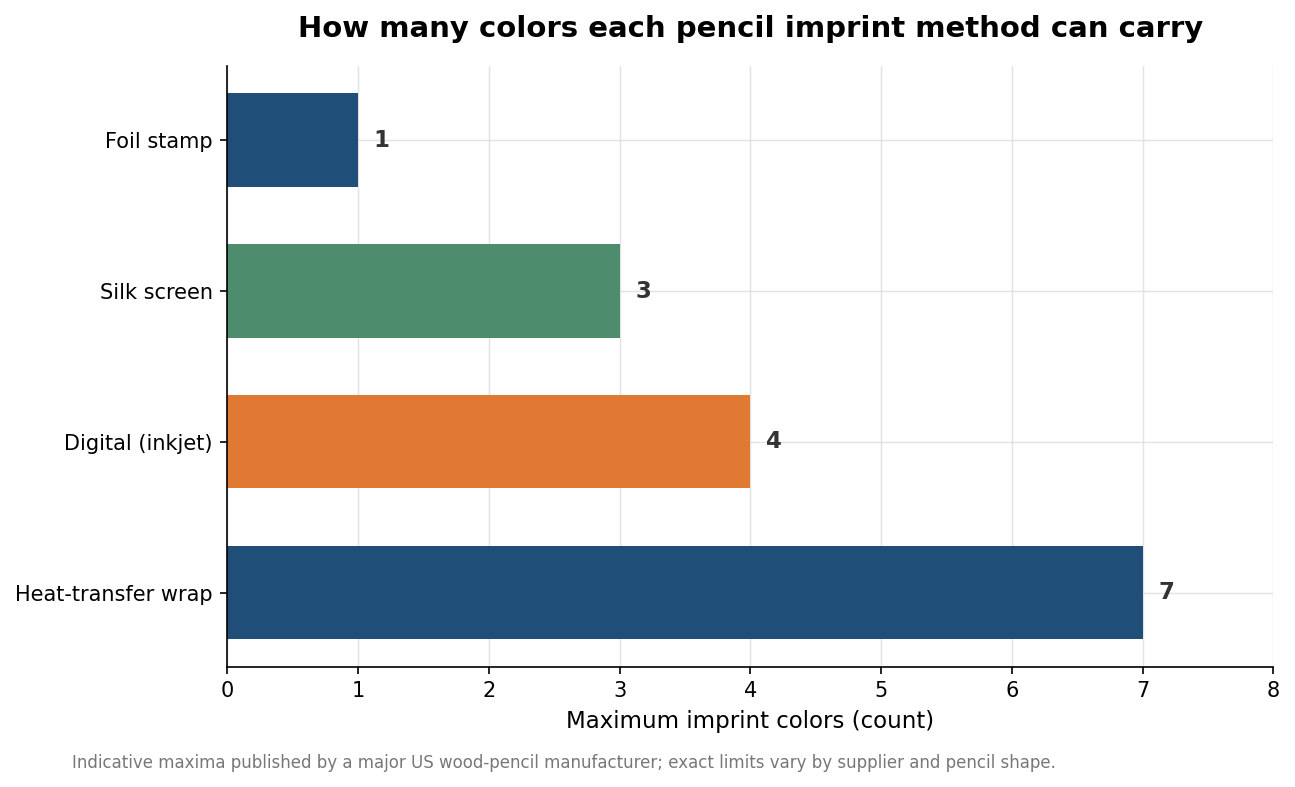
    When one color will not do, three methods open up more of the spectrum. Silk screening pushes ink through a fine mesh, one color at a time, and generally tops out around three colors because each color needs its own screen and its own setup, often about $25 per screen. It holds solid spot colors well, so it suits bold patterns and Pantone-matched brand marks on round pencils. Heat-transfer wraps print your design onto a thin film that is heated and shrunk around the barrel, which is how full-color and photographic artwork ends up on a pencil; depending on the process it can carry up to roughly seven colors, with CMYK digital matching commonly available on runs up to about 1,000 units. Digital inkjet is the newest option and is often tied to the wide, flat face of a carpenter pencil, handling up to about four colors for a small per-unit fee in the range of four cents a pencil. The chart below lays out the practical color ceiling for each method.

    Horizontal bar chart comparing maximum imprint colors by pencil printing method
    Foil stamping is single-color; heat-transfer wraps carry the most colors.

    Design to the imprint window, not the whole pencil

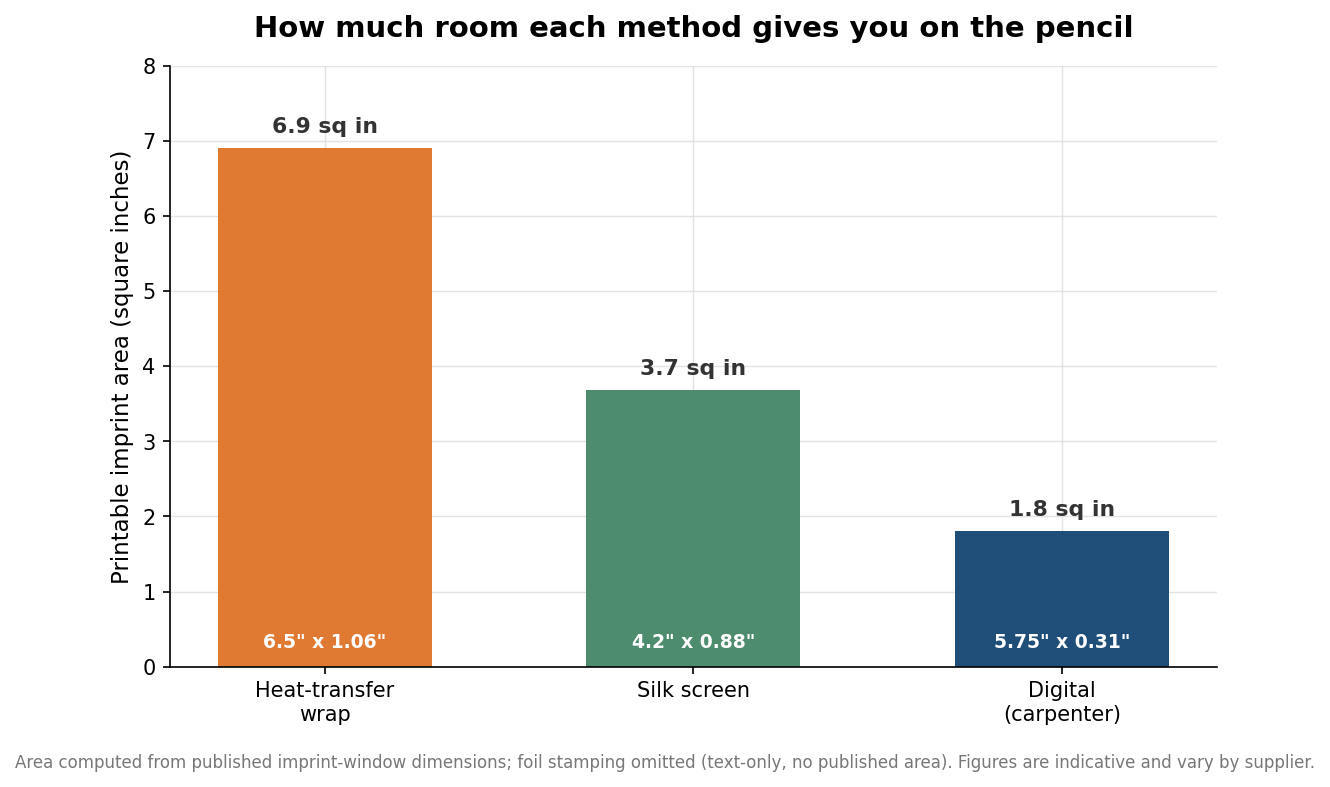
    A pencil is long, but the printable window is smaller than people expect, and each method reserves a different footprint. Heat-transfer wraps give you the most room, with a typical window around 6.5 by just over 1 inch, which is why they carry the busiest artwork. Silk screening prints in a band closer to 4.2 by 0.875 inches, and the carpenter-pencil digital window is long but narrow at about 5.75 by 0.31 inches. Those differences change how a logo should be drawn: a mark that looks balanced in a square will get squeezed or cropped in a narrow strip. Build your artwork to the target window’s proportions, keep critical text away from the very ends where the ferrule and sharpened tip eat into the space, and remember that a wrap can run around the barrel while a foil or screen imprint sits on one face. The next chart compares the printable area you actually get to work with.

    Bar chart comparing printable imprint area in square inches across pencil printing methods
    The printable window varies widely, so artwork should be built to the method’s proportions.

    Files, colors, and proofs before the run

    Once the method is set, the file requirements are straightforward but worth getting right the first time. Vector artwork in AI, EPS, or PDF format reproduces most reliably, since it scales to the tiny imprint window without going soft; raster logos should be high resolution at final size. Call out your colors explicitly with Pantone (PMS) references rather than leaving a screen or digital operator to guess, and specify whether type should be as-drawn or set in the supplier’s default caps. Ask for a proof, either a digital layout or a physical pre-production sample, before the full run, and confirm quantities against any method minimums; digital carpenter runs, for instance, often start around five gross, which is 720 pencils. The prices, imprint sizes, and color limits described here are indicative figures published by established wood-pencil manufacturers and will vary from supplier to supplier, so treat them as a planning baseline and confirm the exact specification on your quote. Do that, and you move from a vague idea to a printable order in a single, well-formed request.

  • Which Custom Pencil Fits Your Event or Brand: A Use-Case Selection Guide

    Which Custom Pencil Fits Your Event or Brand: A Use-Case Selection Guide

    Choosing a custom pencil is really a choice about where it will be used and how much of your message has to fit on it. A pencil handed out at a trade show, one clipped to a scorecard at a golf outing, one riding in a carpenter’s apron, and one going home in a child’s classroom kit are pulling in different directions on size, shape, durability, and print area. Pick the style that matches the setting first, and the imprint, wood, and graphite decisions fall into place behind it.

    The custom pencil world sorts into a handful of well-established body styles, and their dimensions are more standardized than most buyers expect. Getting familiar with those size classes is the fastest way to match a pencil to its job.

    The everyday hex and round pencil

    The full-length hexagonal pencil is the default for a reason. At roughly 7.5 inches long and about a quarter inch across the flats, it is the shape people associate with a “normal” pencil, it resists rolling off a desk, and its long barrel gives a foil-stamped logo and a line of text room to breathe. This is the workhorse for offices, schools, conferences, and general giveaways where you want the pencil to read as familiar and usable rather than novelty. The round pencil shares the 7.5-inch length at a slightly larger diameter and is the easier grip for young hands, which is why jumbo round pencils dominate early-learning kits. Round barrels also accept silkscreen printing, which opens up a larger and more flexible print area than foil stamping alone.

    Golf, bridge, and the small-space pencils

    When the pencil’s job is to be nearby and disposable, the short styles earn their place. The golf or mini pencil runs about 3 inches long, sized to sit in a scorecard holder, a pew card slot, a voting booth, or a library catalog station. The bridge pencil, around 6 inches, splits the difference for card tables and note-taking where a full-length pencil is awkward. These short bodies carry a small imprint area, so they suit a brand name or short line of copy rather than a detailed logo with a tagline. Their advantage is unit economics and ubiquity: they are inexpensive enough to leave out by the hundred and small enough that people pocket them without a second thought, which keeps your name in circulation.

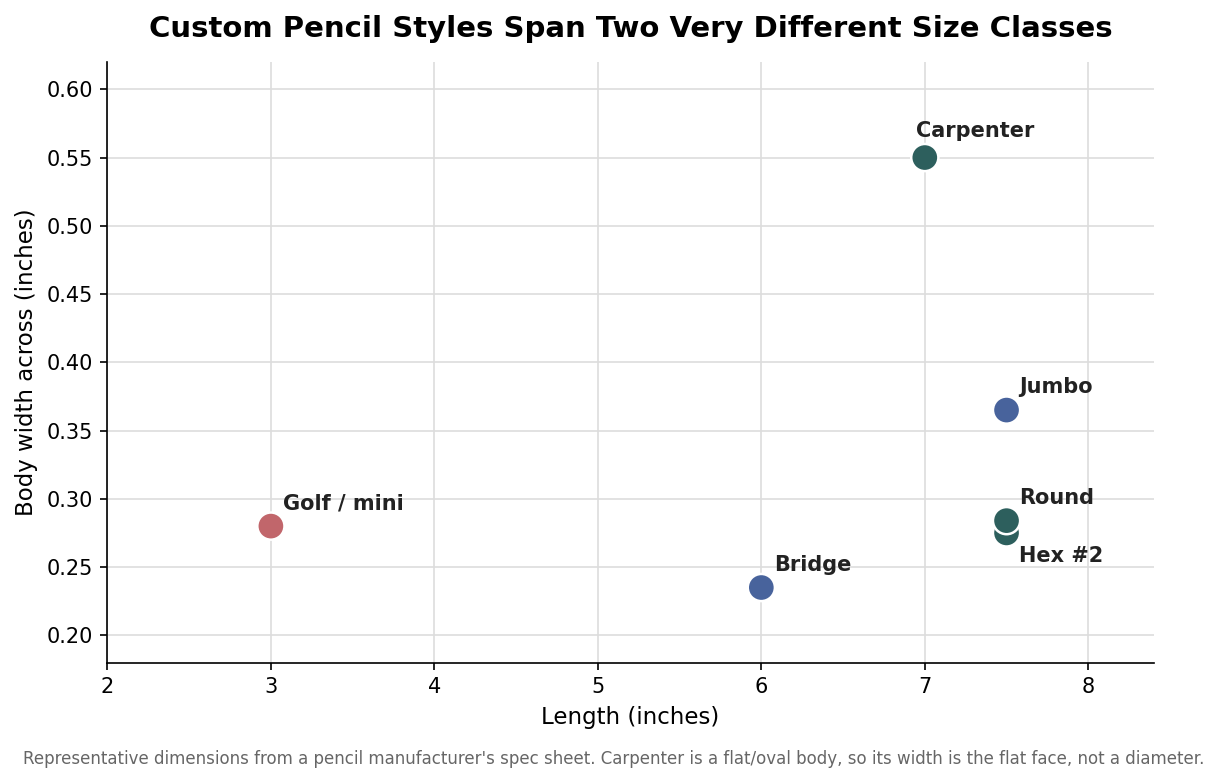
    The chart below plots the common styles by length and body width, and the split between the small-space pencils and the full-length group is stark. Matching that size class to your setting is the single most consequential decision in the spec.

    Scatter plot of custom pencil styles by length and body width, showing golf and bridge pencils as short and hex, round, carpenter and jumbo as full length
    Common pencil styles plotted by length and width; the small-space and full-length groups are clearly separate.

    Carpenter pencils for jobsites and trade brands

    The carpenter pencil is the specialist of the group, and it is the right call for any brand that lives on a jobsite. Its flat, oval body, roughly 7 inches long and about half an inch wide, will not roll off a sloped surface or a stack of lumber, and the broad face is a genuine asset for printing. Because the surface is flat and wide, carpenter pencils take digital and multi-color printing well, commonly supporting one- or two-sided imprints and up to four colors, so a full-color logo that would be cramped on a round barrel sits comfortably here. For contractors, hardware suppliers, building-supply yards, and trade shows aimed at the trades, a carpenter pencil signals that you understand the work, which is worth more than the few cents of added cost over a standard pencil.

    Specialty and eco options: seed, recycled, and jumbo

    Specialty pencils trade some versatility for a specific message. Seed pencils, which are designed to be planted once too short to write with, and pencils made from recycled paper or reclaimed wood, carry an explicit sustainability story and suit brands whose audience rewards that positioning. Jumbo pencils, with a barrel in the range of a third of an inch or more across, give you the most print real estate of any style, often accommodating multiple colors and several lines of copy, which makes them useful for detailed instructions or a bold classroom brand. The tradeoff across all of these is that a specialty body is a statement, so choose one when the message is the point rather than defaulting to it for a general handout.

    Wood choice sits underneath all of these. Incense-cedar is the traditional premium pencil wood because it sharpens evenly without splintering and is gentle on sharpeners, while basswood and poplar are common budget woods that sharpen adequately but can splinter a little more. If your pencils will actually be sharpened and used, as opposed to kept as keepsakes, the wood is not a detail to ignore.

    Graphite grade and the finishing touches

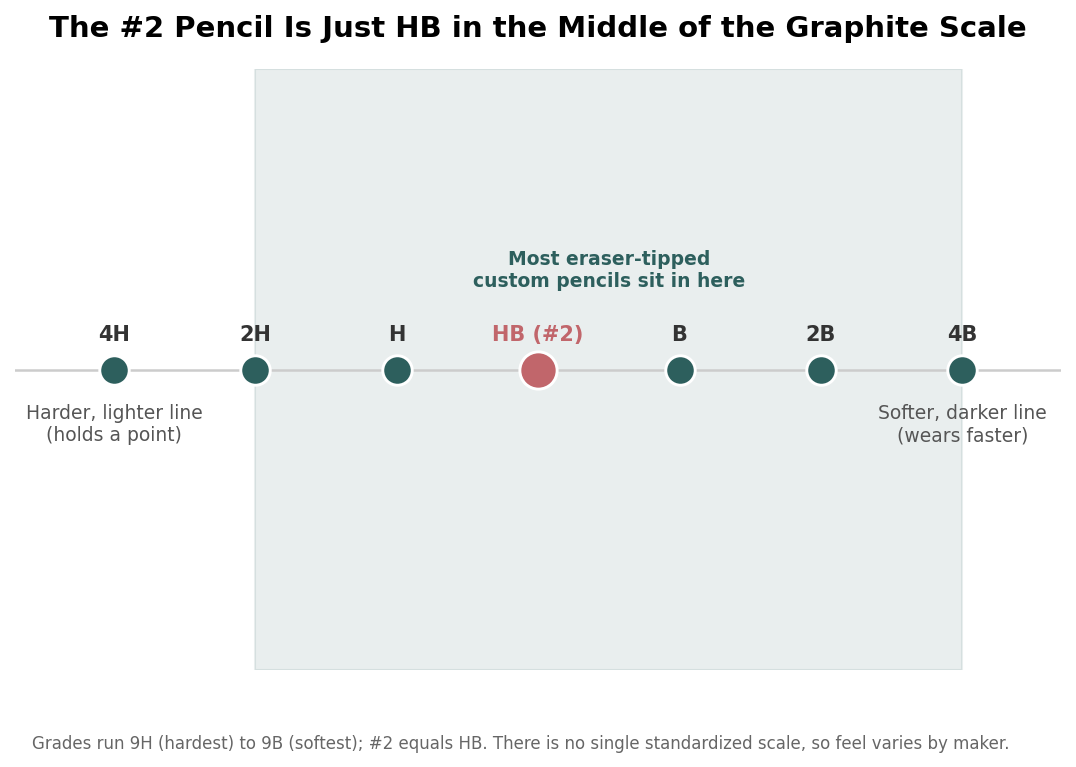
    Do not overlook what is inside the pencil. Graphite is graded from hard to soft, and for a writing pencil that people will actually use, the familiar #2, which is the same as HB, sits in the sweet spot: dark enough to read easily, hard enough to hold a point through a meeting. Harder grades toward the H end write lighter and last longer but can feel scratchy, while softer grades toward the B end lay down a darker, smoother line that wears down faster. Most eraser-tipped custom pencils land in the middle of that range, as the scale below shows, and unless you have a specific reason to move off it, HB is the safe default.

    Number line of graphite grades from 4H to 4B with HB, the #2 grade, highlighted in the middle
    The graphite hardness scale, with the everyday #2 (HB) grade sitting in the middle of the usable range.

    The finishing choices are where a custom pencil earns its polish. Foil stamping gives the shiny, familiar imprint most people picture and is the popular default; silkscreen offers a larger print area on round barrels; and a full foil wrap can cover the entire body in a design. Ferrules and erasers come in standard colors such as gold, silver, and black for the metal band and pink, white, or black for the eraser, and a Pantone match on the barrel lets the pencil carry your exact brand color. None of these is expensive on its own, but together they turn a generic pencil into one that looks deliberately yours.

    Work in that order, from setting to style to graphite to finish, and the specification is coherent rather than a pile of preferences. A golf outing gets a 3-inch mini with a short foil imprint; a contractor’s trade show gets a four-color carpenter pencil; a classroom gets a jumbo round in HB. The pencil fits the moment because you chose the moment first.

  • Why Pencil Leads Break

    People blame themselves, or the sharpener. Usually neither is at fault.

    How a pencil is made

    Two slats of wood are grooved, a core is laid into one, glue is applied, the second slat is clamped on top, and the block is then milled into individual pencils and lacquered.

    Everything that matters happens in that glue-up. The core must be bonded to both halves and sit centred in the barrel.

    What an unbonded core does

    If the core is loose in the groove, the wood flexes independently of it every time the pencil is used or dropped. The core fractures at intervals along its whole length, inside the barrel, where you cannot see it.

    Then every sharpening exposes a fresh break. The pencil is not breaking because you sharpened it; it broke weeks ago and you are only now reaching the crack.

    What an off-centre core does

    Sharpening reveals more wood on one side than the other and the point comes out lopsided and weak. Press on it and it snaps at the shoulder.

    You can see this one: look at a sharpened point end-on and check the core sits in the middle.

    What you can actually control

    Buy pencils with a bonded, centred core, and use a sharp blade — a blunt rotary sharpener tears rather than cuts and will break even a good pencil.

    Beyond that, dropping pencils point-down onto a hard floor genuinely does damage the core. It is the one user error in this list.

  • Do Seed Pencils Actually Grow?

    Seed pencils are one of the most-ordered eco giveaways and one of the most often disappointing. The reason is always the same.

    What they are

    An ordinary pencil with a small capsule at the blunt end holding seed. When the pencil is too short to use, the capsule is planted rather than the stub being binned.

    It is a genuinely nice idea and people do photograph them, which is most of why they get bought.

    Why they fail

    Because nobody is told what to do. A capsule pushed into dry ground, too deep, in the wrong season, grows nothing — and the recipient reasonably concludes the seeds were never viable.

    Species matters too. Fussy or slow-germinating seed makes a bad giveaway however good the intention.

    What we do about it

    We print the species, the planting season, the depth and the watering on the pack, and we stick to herbs and reliable wildflowers.

    And if your event is in the wrong season, we will say so and suggest a recycled-barrel pencil instead. A giveaway that fails quietly costs more goodwill than it buys.

    The quieter alternative

    A recycled newspaper-barrel pencil makes no promise it cannot keep: no new timber, sharpens fine, recyclable, plastic-free packing available.

    It photographs less well and it disappoints nobody, which for most programmes is the better trade.

  • The Complete Buyer’s Guide to Custom Pencils

    Pencils are bought on unit price and judged on whether they sharpen. These four questions decide the second part.

    Ask whether the core is bonded

    The core should be glued to both wood slats and sit centred in the barrel. If it is not, the slats flex in use, the core fractures along its length inside where you cannot see it, and the pencil breaks repeatedly however carefully it is sharpened.

    It is the single most common complaint about cheap promotional pencils and the one thing no listing mentions. Ask the question; a supplier who has specified it will answer immediately.

    Timber decides how it sharpens

    Cedar cuts cleanly and gives a crisp collar around the point. Cheaper hardwoods tear and leave a ragged fibrous edge, and they blunt a knife faster if the pencils are for trades.

    Recycled newspaper barrels are a genuine third option: no new timber, sharpen well, slightly softer under the blade.

    Length is a use decision, not a saving

    Full length for classrooms, desks and anywhere a pencil lives in a pot. Half length for scorecards, pockets, polling booths and surveys, where a full pencil does not fit.

    At high volume the timber saving on half length is real, but choose it because of where it is going, not because it is cheaper.

    Then the imprint

    A pencil is a very long, very narrow canvas. Almost every logo needs setting out again rather than scaling — wordmarks work, detailed crests rarely do at 7mm.

    Foil stamping on lacquered or raw wood looks considerably more expensive than print and usually costs very little more. And if you want a different name on every pencil, that should not carry a surcharge.

    What to send when you ask for a quote

    Quantity, length, timber preference, whether you want an eraser, pre-sharpened or not, artwork, and any name list. That is enough for a real quote and a mockup the same day.

  • Hello world!

    Welcome to WordPress. This is your first post. Edit or delete it, then start writing!