Choosing a custom pencil is really a choice about where it will be used and how much of your message has to fit on it. A pencil handed out at a trade show, one clipped to a scorecard at a golf outing, one riding in a carpenter’s apron, and one going home in a child’s classroom kit are pulling in different directions on size, shape, durability, and print area. Pick the style that matches the setting first, and the imprint, wood, and graphite decisions fall into place behind it.
The custom pencil world sorts into a handful of well-established body styles, and their dimensions are more standardized than most buyers expect. Getting familiar with those size classes is the fastest way to match a pencil to its job.
The everyday hex and round pencil
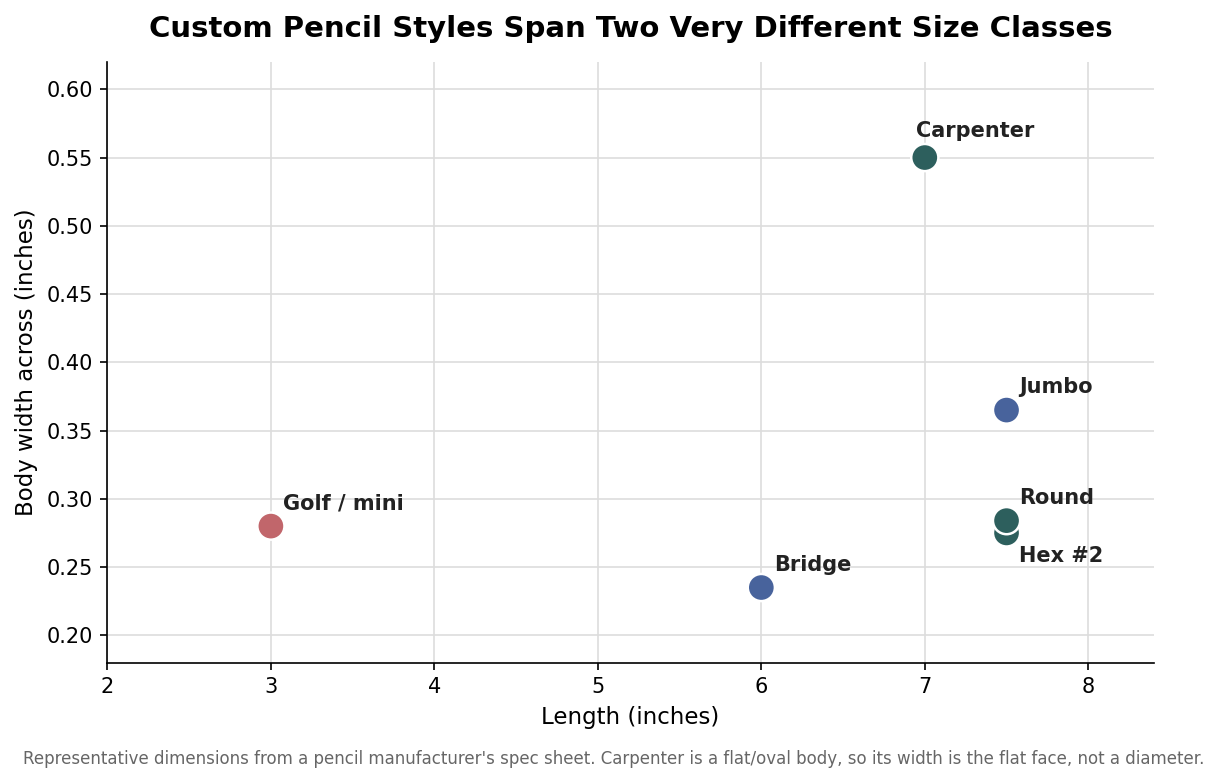
The full-length hexagonal pencil is the default for a reason. At roughly 7.5 inches long and about a quarter inch across the flats, it is the shape people associate with a “normal” pencil, it resists rolling off a desk, and its long barrel gives a foil-stamped logo and a line of text room to breathe. This is the workhorse for offices, schools, conferences, and general giveaways where you want the pencil to read as familiar and usable rather than novelty. The round pencil shares the 7.5-inch length at a slightly larger diameter and is the easier grip for young hands, which is why jumbo round pencils dominate early-learning kits. Round barrels also accept silkscreen printing, which opens up a larger and more flexible print area than foil stamping alone.
Golf, bridge, and the small-space pencils
When the pencil’s job is to be nearby and disposable, the short styles earn their place. The golf or mini pencil runs about 3 inches long, sized to sit in a scorecard holder, a pew card slot, a voting booth, or a library catalog station. The bridge pencil, around 6 inches, splits the difference for card tables and note-taking where a full-length pencil is awkward. These short bodies carry a small imprint area, so they suit a brand name or short line of copy rather than a detailed logo with a tagline. Their advantage is unit economics and ubiquity: they are inexpensive enough to leave out by the hundred and small enough that people pocket them without a second thought, which keeps your name in circulation.
The chart below plots the common styles by length and body width, and the split between the small-space pencils and the full-length group is stark. Matching that size class to your setting is the single most consequential decision in the spec.
Carpenter pencils for jobsites and trade brands
The carpenter pencil is the specialist of the group, and it is the right call for any brand that lives on a jobsite. Its flat, oval body, roughly 7 inches long and about half an inch wide, will not roll off a sloped surface or a stack of lumber, and the broad face is a genuine asset for printing. Because the surface is flat and wide, carpenter pencils take digital and multi-color printing well, commonly supporting one- or two-sided imprints and up to four colors, so a full-color logo that would be cramped on a round barrel sits comfortably here. For contractors, hardware suppliers, building-supply yards, and trade shows aimed at the trades, a carpenter pencil signals that you understand the work, which is worth more than the few cents of added cost over a standard pencil.
Specialty and eco options: seed, recycled, and jumbo
Specialty pencils trade some versatility for a specific message. Seed pencils, which are designed to be planted once too short to write with, and pencils made from recycled paper or reclaimed wood, carry an explicit sustainability story and suit brands whose audience rewards that positioning. Jumbo pencils, with a barrel in the range of a third of an inch or more across, give you the most print real estate of any style, often accommodating multiple colors and several lines of copy, which makes them useful for detailed instructions or a bold classroom brand. The tradeoff across all of these is that a specialty body is a statement, so choose one when the message is the point rather than defaulting to it for a general handout.
Wood choice sits underneath all of these. Incense-cedar is the traditional premium pencil wood because it sharpens evenly without splintering and is gentle on sharpeners, while basswood and poplar are common budget woods that sharpen adequately but can splinter a little more. If your pencils will actually be sharpened and used, as opposed to kept as keepsakes, the wood is not a detail to ignore.
Graphite grade and the finishing touches
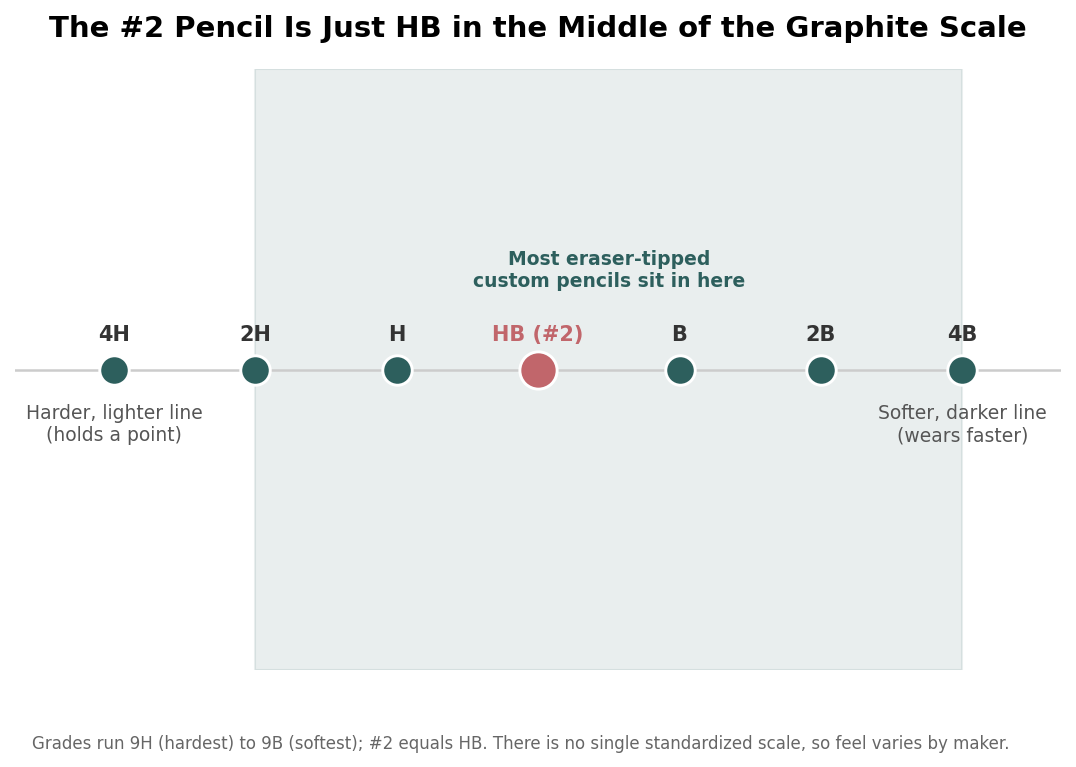
Do not overlook what is inside the pencil. Graphite is graded from hard to soft, and for a writing pencil that people will actually use, the familiar #2, which is the same as HB, sits in the sweet spot: dark enough to read easily, hard enough to hold a point through a meeting. Harder grades toward the H end write lighter and last longer but can feel scratchy, while softer grades toward the B end lay down a darker, smoother line that wears down faster. Most eraser-tipped custom pencils land in the middle of that range, as the scale below shows, and unless you have a specific reason to move off it, HB is the safe default.
The finishing choices are where a custom pencil earns its polish. Foil stamping gives the shiny, familiar imprint most people picture and is the popular default; silkscreen offers a larger print area on round barrels; and a full foil wrap can cover the entire body in a design. Ferrules and erasers come in standard colors such as gold, silver, and black for the metal band and pink, white, or black for the eraser, and a Pantone match on the barrel lets the pencil carry your exact brand color. None of these is expensive on its own, but together they turn a generic pencil into one that looks deliberately yours.
Work in that order, from setting to style to graphite to finish, and the specification is coherent rather than a pile of preferences. A golf outing gets a 3-inch mini with a short foil imprint; a contractor’s trade show gets a four-color carpenter pencil; a classroom gets a jumbo round in HB. The pencil fits the moment because you chose the moment first.